PISA 2025 Results (Volume I): Albania

Table of contents
The Programme for International Student Assessment (PISA) assesses the knowledge, skills and attitudes of 15-year-old students. The tests explore how well students can solve complex problems, think critically and communicate effectively; data collected through questionnaires describe the context in which students learn. This gives insights into how well education systems are preparing students for real life challenges and future success. Albania participated for the first time in PISA in 2001. By comparing results internationally, policy makers and educators in Albania can learn from other countries’ policies and practices.
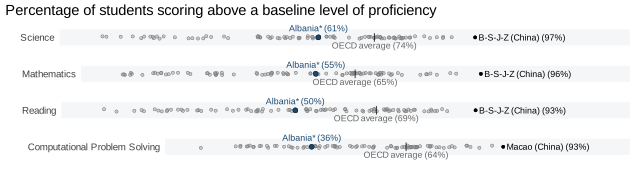
Notes: Due to missing data, not all countries and economies are included in every dimension. For each dimension, the top country/economy and the OECD average are highlighed.
Definitions: Percentage of students scoring above a baseline level of proficiency: students scoring at or above Level 2 in science, mathematics and reading; at or above Level 3 in computational problem solving.
Source: Figure I.1.2.
An interactive dashboard is available at https://www.oecd.org/en/data/dashboards/pisa-education-and-skills.html
Notes on data quality in PISA 2025
This edition of PISA includes data from 91 countries and economies. While the vast majority of countries and economies met PISA’s technical standards, a small number did not. In particular, caution is required when interpreting results of countries and economies mentioned in this note with an asterisk (*) next to their names: their results could be affected by greater uncertainty, or even be biased, because one or more PISA sampling standards were not met. For more information, see the Reader’s Guide in PISA 2025 Results, Volume I and Chapter 18 (Data Adjudication) in the PISA 2025 Technical Report.
In Albania, schools with fewer than 21 PISA-eligible students were not contacted to conduct assessment sessions; as a result, these schools did not participate in PISA 2025. Empirical evidence from prior cycles and from auxiliary contextual indicators suggests that these schools differ from participating schools in both socio-economic composition and academic outcomes. At the same time, even in a strong negative-bias scenario, the resulting bias is unlikely to exceed 7.3% of a standard deviation, and a plausible lower bound for the mean score in science is 429 score points. Because the complete absence of small schools implies a structural coverage gap that cannot be fully corrected using statistical adjustments, the reporting of results for Albania in international reports is limited, with no trend reporting and limited reporting of information collected through questionnaires.
Students in Albania scored less than the OECD average in mathematics, reading and science (Figure 2).
A smaller proportion of students in Albania than on average across OECD countries were top performers (Level 5 or 6) in at least one subject. At the same time, a smaller proportion of students than on average across OECD countries achieved a minimum level of proficiency (Level 2 or higher) in all three subjects (Figure 3).
In computational problem solving, the mean score of students in Albania was lower than the OECD average (Figure 2).
Albania, OECD average and selected comparison countries/economies

Notes: Comparison countries/economies include the highest-performing countries and economies overall and the highest-performing OECD countries; for comparisons with all remaining PISA 2025 participants, see source Tables and Figures. Horizontal lines that extend beyond the markers represent a measure of uncertainty associated with mean scores (the 95% confidence interval).
Albania and OECD average

Source: Tables I.B1.2a.10-12
Some 61% of students in Albania attained Level 2 or higher in science (OECD average: 74%). At a minimum, these students can recognize the correct explanation for familiar scientific phenomena and can use such knowledge to identify, in simple cases, whether a conclusion is valid based on the data provided. Over 85% of students in top performers B-S-J-Z (China), Macao (China), Singapore, Estonia, Japan, Chinese Taipei and Korea (in descending order of that share) performed at this level or above.
In Albania, 1% of students were top performers in science, meaning that they were proficient at Level 5 or 6 (OECD average: 7%). These students can creatively and autonomously apply their knowledge of and about science to a wide variety of situations, including unfamiliar ones.
In Albania, 55% of students attained at least Level 2 proficiency in mathematics (OECD average: 65%). At a minimum, these students can interpret and recognize, without direct instructions, how a simple situation can be represented mathematically (e.g. comparing the total distance across two alternative routes, or converting prices into a different currency).
Some 2% of students in Albania were top performers in mathematics, meaning that they attained Level 5 or 6 in the PISA mathematics test (OECD average: 8%). The largest shares of students attaining Level 5 or 6 were observed in Seven Asian countries and economies: B-S-J-Z (China) (54%), Singapore (37%), Chinese Taipei (32%), Macao (China) (29%), Korea (23%), Japan (22%) and Hong Kong (China) (21%). At these levels, students can model complex situations mathematically, and can select, compare and evaluate appropriate problem-solving strategies for dealing with them. In 13 countries and economies participating in PISA 2025, more than 10% of students attained Level 5 or 6 proficiency.
Some 50% of students in Albania attained Level 2 or higher in reading (OECD average: 69%). At a minimum, these students can identify the main idea in a text of moderate length, find information based on explicit, though sometimes complex criteria, and can reflect on the purpose and form of texts when explicitly directed to do so. The share of 15-year-old students who attained minimum levels of proficiency in reading (Level 2 or higher) varied from 93% in B-S-J-Z (China) to 4% in Rwanda.
In Albania, almost no students scored at Level 5 or higher in reading (OECD average: 6%). These students can comprehend lengthy texts, deal with concepts that are abstract or counterintuitive, and establish distinctions between fact and opinion, based on implicit cues pertaining to the content or source of the information.
The PISA 2025 survey focused on science, with mathematics and reading as minor areas; an assessment of learning in the digital world measured students’ computational problem-solving skills and their ability to self-direct their learning in a digital environment. Results for science, mathematics, reading and computational problem solving are released on 8 September 2026 and analyses of students’ self-directed learning in 2027.
Over 760 000 students took the assessment in 2025, representing about 33 million 15-year-olds in the schools of the 91 participating countries and economies.
In Albania, 5 959 students, in 160 schools, completed the assessment, representing about 22 800 15-year-old students (an estimated 72% of the total population of 15-year-olds).
PISA students are aged between 15 years 3 months and 16 years 2 months at the time of the assessment, and they have completed at least 6 years of formal schooling. In this note, they are referred to as 15-year-old students.
Students took a two hour test, and each student was tested in two subjects. Different students were given different test questions and different combinations of subjects (e.g. science followed by reading, or mathematics followed by science, etc.). Test items were a mixture of multiple-choice questions and questions requiring students to construct their own responses.
Students also answered a background questionnaire, which took about 35 minutes to complete. The questionnaire sought information about the students themselves, their attitudes, dispositions and beliefs, their homes, and their school and learning experiences. School principals completed a questionnaire about school management, organisation, and the learning environment.
Some countries/economies also distributed additional questionnaires, to students, parents and/or teachers, to elicit more information. The findings from these optional questionnaires are not covered by this note.
Contact
For more information about PISA 2025 visit www.oecd.org/pisa
Explore, compare and visualise more data and analysis using http://gpseducation.oecd.org.
Questions can be directed to the PISA team at the Directorate for Education and Skills: edu.pisa@oecd.org.
This note was written by Francesco Avvisati (OECD Directorate for Education and Skills).
This work is published under the responsibility of the Secretary-General of the OECD. The opinions expressed and arguments employed herein do not necessarily reflect the official views of the Member countries of the OECD.
This document, as well as any data and map included herein, are without prejudice to the status of or sovereignty over any territory, to the delimitation of international frontiers and boundaries and to the name of any territory, city or area.
The statistical data for Israel are supplied by and under the responsibility of the relevant Israeli authorities. The use of such data by the OECD is without prejudice to the status of the Golan Heights, East Jerusalem and Israeli settlements in the West Bank under the terms of international law.
Note by the Republic of Türkiye
The information in this document with reference to “Cyprus” relates to the southern part of the Island. There is no single authority representing both Turkish and Greek Cypriot people on the Island. Türkiye recognises the Turkish Republic of Northern Cyprus (TRNC). Until a lasting and equitable solution is found within the context of the United Nations, Türkiye shall preserve its position concerning the “Cyprus issue”.
Note by all the European Union Member States of the OECD and the European Union
The Republic of Cyprus is recognised by all members of the United Nations with the exception of Türkiye. The information in this document relates to the area under the effective control of the Government of the Republic of Cyprus.
Kosovo: This designation is without prejudice to positions on status, and is in line with United Nations Security Council Resolution 1244/99 and the Advisory Opinion of the International Court of Justice on Kosovo’s declaration of independence.
The full book is available in English: OECD (2026), PISA 2025 Results (Volume I): Future-Ready Students, PISA, OECD Publishing, Paris, https://doi.org/10.1787/73451bc5-en.
© OECD 2026
 Attribution 4.0 International (CC BY 4.0)
This work is made available under the Creative Commons Attribution 4.0 International licence. By using this work, you accept to be bound by the terms of this licence (https://creativecommons.org/licenses/by/4.0/).
Attribution – you must cite the work.
Translations – you must cite the original work, identify changes to the original and add the following text: In the event of any discrepancy between the original work and the translation, only the text of the original work should be considered valid.
Adaptations – you must cite the original work and add the following text: This is an adaptation of an original work by the OECD. The opinions expressed and arguments employed in this adaptation should not be reported as representing the official views of the OECD or of its Member countries.
Third-party material – the licence does not apply to third-party material in the work. If using such material, you are responsible for obtaining permission from the third party and for any claims of infringement.
You must not use the OECD logo, visual identity or cover image without express permission or suggest the OECD endorses your use of the work.
Any dispute arising under this licence shall be settled by arbitration in accordance with the Permanent Court of Arbitration (PCA) Arbitration Rules 2012. The seat of arbitration shall be Paris (France). The number of arbitrators shall be one.